
Travelling directly from Udaipur to Jodhpur is possible in a day, but doing so means passing through one of the most rewarding sections of Rajasthan without giving it much attention. Between the two cities lie Aravalli hills, enormous forts, intricately carved temples, old villages, granite leopard habitat and some excellent countryside roads.
For travellers searching for places to visit between Udaipur and Jodhpur, the strongest route is not necessarily the fastest highway connection.
A more rewarding journey can run through Kumbhalgarh, Ranakpur, Narlai and Jawai before reaching Jodhpur. Depending on available time, these places can be treated as sightseeing stops or converted into a two- to four-night road journey.
The direct Udaipur to Jodhpur distance is generally around 250 kilometres depending on the selected road, and a straightforward transfer commonly requires approximately five to six hours under normal conditions. Adding Kumbhalgarh, Ranakpur or Jawai changes both the distance and journey time considerably.
Trying to see all of them during one transfer day is a mistake.
Kumbhalgarh Fort alone deserves several hours. Ranakpur should not be reduced to a ten-minute photograph. Jawai's principal leopard safari hours fall around sunrise and sunset, making an overnight stay essential for travellers who actually want a wildlife experience.
A much better structure is to convert the transfer into a short Udaipur to Jodhpur road trip.
With one additional night, Ranakpur can be combined with a countryside stay. With two nights, Jawai becomes practical. With three or four nights, Kumbhalgarh, Ranakpur, Narlai and Jawai can all receive meaningful time.
Kumbhalgarh is one of the most substantial attractions that can be added between Udaipur and Jodhpur, although reaching it requires taking a route through the Aravalli region rather than simply following the quickest city-to-city road.
Rajasthan Tourism places Kumbhalgarh Fort approximately 84 kilometres north of Udaipur. The road journey commonly takes around two to three hours depending on traffic, road conditions and the traveller's starting point in Udaipur.
The fort was constructed during the reign of Rana Kumbha and is famous for its enormous defensive wall. Rajasthan Tourism states that the wall extends for approximately 36 kilometres, making the scale of the fortification one of Kumbhalgarh's defining features.
The elevated setting matters just as much as the architecture.
The fort rises above the surrounding Aravalli landscape, and the approach road provides a noticeable transition away from Udaipur's urban environment. Travellers interested in landscape photography should therefore avoid treating Kumbhalgarh as only a historical stop.
Keep at least three to four hours for the fort area if walking comfortably and taking photographs.
The site involves slopes and steps, so footwear matters. Rajasthan can also become extremely warm during the middle of the day. Carry drinking water, sun protection and a hat during hotter periods.
Current entry fees and visiting hours should be confirmed before arrival because ticket structures can change. Travellers should also check whether any special event or maintenance work affects access.
An overnight stay around Kumbhalgarh makes sense when the itinerary is not rushed.
Travellers can reach the region from Udaipur during the morning, visit the fort later in the day and continue towards Ranakpur the following morning. This avoids forcing several major attractions into one long transfer.
The surrounding Kumbhalgarh Wildlife Sanctuary also gives the region a different identity from Udaipur. Wildlife associated with the wider landscape includes leopards, wolves, hyenas, jackals, sloth bears and various herbivores, although sightings should never be expected simply because a traveller is driving through the region.
For a nature-focused journey, the hills and dry forest are part of the attraction.
From Kumbhalgarh, Ranakpur becomes the natural next destination.
Don’t simply pass through Rajasthan—experience it. Discover the Aravalli hills, heritage towns, sacred temples and Jawai’s wild leopard country with a thoughtfully paced stay that turns your journey into a collection of unforgettable experiences.
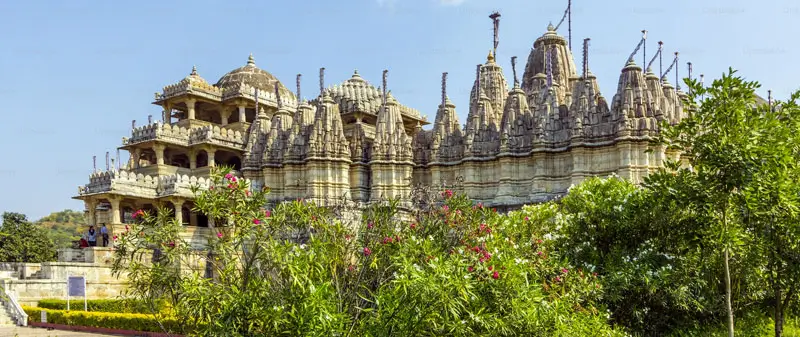
Ranakpur is one of the most practical and rewarding stops between Udaipur and Jodhpur.
Its famous Jain temple is known for detailed marble carving and a remarkable interior supported by numerous carved pillars. Even travellers who have already visited several temples in Rajasthan should allow enough time here because the architectural experience is substantially different from a quick roadside shrine.
The temple sits within a valley framed by the Aravallis.
That setting makes the journey particularly attractive after Kumbhalgarh. Depending on the exact route, the drive between the two areas generally requires around 1.5 to 2.5 hours.
Visitors should confirm current tourist access hours before arriving.
Temple rules deserve particular attention. Clothing should be respectful, and restrictions can apply to photography, leather items, food and other belongings. Some visitor services or camera permissions may involve charges.
Do not rely on a several-year-old social-media post for current ticket or camera information.
Keeping around 1.5 to 2 hours for the temple area provides a more comfortable visit than rushing back to the vehicle after thirty minutes.
Lunch can then be taken around Ranakpur before continuing.
Travellers who prefer village-scale heritage can add Narlai.
Narlai lies in the wider Pali region and works particularly well for travellers who want to spend a night somewhere quieter than Udaipur or Jodhpur. The area combines a historic settlement, rocky surroundings and heritage accommodation.
This is where the road trip becomes more interesting than a list of monuments.
An evening village walk, a relaxed dinner at a heritage property and a quiet morning can provide a useful break between major sightseeing days.
Travellers with only one additional night between Udaipur and Jodhpur can choose either the Ranakpur/Narlai area or Jawai depending on their priority.
Choose Ranakpur and Narlai for temples, heritage and countryside.
Choose Jawai for leopard safari and wildlife.
Travellers with two or three additional nights do not need to choose. Ranakpur can be visited during the day before continuing to Jawai for a two-night wildlife stay.
That route is particularly efficient because the Ranakpur to Jawai distance is generally around 65–90 kilometres depending on the exact starting point, destination and road selected. A practical driving allowance is around 1.5 to 2.5 hours.
Jawai is the stop that changes the character of the entire Udaipur to Jodhpur trip.
Instead of moving from one heritage city to another, travellers spend time in a landscape of granite formations, scrub, fields, villages and water bodies where leopards live among the rocky hills.
This is not a conventional national park safari.
Safari vehicles move through the wider leopard landscape while drivers and trackers watch ridges, caves and rocky outcrops for animal movement.
For this reason, Jawai cannot be treated as a two-hour sightseeing stop.
A traveller arriving at noon and leaving at 3:00 PM is unlikely to understand what makes the destination special. Leopard safari activity is concentrated around early morning and evening hours when conditions are more suitable.
At Jawai Nature Stay, the currently listed seasonal Jawai leopard safari timings are approximately 5:00 AM to 8:00 AM and 5:00 PM to 8:00 PM in summer. During winter, approximate timings are 6:00 AM to 9:00 AM and 4:00 PM to 7:00 PM.
Actual reporting times should be reconfirmed before arrival because daylight and local operating conditions can affect departures.
The property currently lists a private Jawai leopard safari price of approximately ₹4,500 per Gypsy per safari.
This is a vehicle rate rather than a reason to judge the trip purely on a per-person basis. Couples, families and small private groups can take the vehicle together, subject to the operator's permitted capacity and arrangements.
Two safaris would therefore currently work out at approximately ₹9,000 per Gypsy, before accommodation and meals.
A two-night stay is ideal for most first-time visitors.
Arrive from Ranakpur during the afternoon and take an evening safari if the timing works. The next morning can be used for another leopard drive. After breakfast, spend the middle of the day resting before visiting Jawai Dam or taking another evening activity.
Jawai Dam adds birdlife and crocodile habitat to the trip. Binoculars are useful, particularly for guests interested in waterbirds.
Wildlife photography requires patience.
Leopards may remain high on granite formations, so a telephoto lens is far more useful than assuming every animal will approach the vehicle. Wildlife sightings can never responsibly be guaranteed.
Jawai is also geographically useful.
After the stay, Jawai to Jodhpur generally requires roughly three to four hours by road depending on the accommodation location, selected route, traffic and stops.
That makes Jawai one of the strongest wildlife additions to a route already connecting Udaipur and Jodhpur.
Not every worthwhile place between the two cities requires an overnight stay.
Muchhal Mahavir Temple can be considered by travellers moving through the Ranakpur region. The temple is dedicated to Lord Mahavir and sits in the broader Kumbhalgarh sanctuary landscape.
It is best treated as a regional addition rather than a destination requiring an entire day.
Travellers should ask their driver about current road conditions and the additional journey time before adding it. A small detour that appears insignificant on a map can take much longer on rural roads.
This principle applies to several smaller temples, villages and viewpoints across the route.
The temptation on a private Rajasthan road trip is to add every attraction found online. That can quickly turn a relaxed journey into a sequence of car parks.
A useful rule is to keep one major attraction and one smaller stop per travel day.
For example, a Kumbhalgarh day can focus primarily on the fort, with a village or viewpoint added if time permits.
A Ranakpur day should give the Jain temple enough time before adding Narlai or continuing towards Jawai.
A Jawai day should be organised around safari timing rather than trying to squeeze a distant fort into the middle of the schedule.
There are also opportunities simply to stop for landscape views.
The Aravalli region changes with season. Dry months produce muted brown and golden hills, while rainfall can transform sections of the route. Agricultural areas also change according to local cropping patterns.
Travellers should never stop a vehicle in an unsafe position simply for photographs. Use proper pull-offs or ask the driver to identify a safe place.
Food stops require some thought as well.
Udaipur and Jodhpur provide abundant restaurant choices, but rural sections have fewer premium dining options. Eating at the hotel in Kumbhalgarh, Ranakpur, Narlai or Jawai can be more convenient than searching for a restaurant late in the evening.
Carry drinking water and some simple snacks during longer drives.
Guests with strict dietary requirements should tell their accommodation in advance, particularly at smaller rural properties.
Go beyond the usual city-to-city route and discover Kumbhalgarh, Ranakpur, Narlai and Jawai at a relaxed pace. Add a private leopard safari and experience the landscapes, heritage and wilderness that lie between Rajasthan’s iconic cities.
The amount of available time should determine the route.
With only a direct transfer day, Ranakpur is generally one of the most practical major sightseeing additions, provided the detour and temple access hours work with the departure schedule.
Do not attempt Kumbhalgarh, Ranakpur and Jawai on the same direct-transfer day.
With one overnight stop, travellers interested in heritage can use:
Udaipur - Kumbhalgarh - Ranakpur/Narlai - Jodhpur
The day remains substantial, so one overnight stay around Kumbhalgarh, Ranakpur or Narlai makes it much more comfortable.
For wildlife travellers with two nights available, a stronger route is:
Udaipur - Ranakpur - Jawai - Jodhpur
Visit Ranakpur during the transfer and spend two nights in Jawai. This creates enough time for at least two leopard safari opportunities.
With three nights available:
Udaipur - Kumbhalgarh - Ranakpur - Jawai - Jodhpur
One night can be allocated around Kumbhalgarh or Ranakpur and two nights in Jawai.
With four nights, the journey becomes genuinely relaxed.
A traveller could stay one night around Kumbhalgarh, one around Narlai or Ranakpur and two nights in Jawai.
The cost of the private car depends on vehicle type and kilometre policy.
For a sedan or SUV with driver, keep a broad working budget of around ₹3,500–₹6,500 per day. Larger premium vehicles can cost more.
Always ask whether the quotation includes tolls, parking, driver allowance and taxes. Multi-day operators may apply a minimum number of kilometres per day even when the actual driving distance is shorter.
Accommodation adds another ₹5,000–₹15,000 per room per night for many comfortable properties, although premium heritage hotels and luxury Jawai camps can cost far more.
The objective should not be finding the cheapest possible transfer.
A well-paced road trip converts what would have been five or six hours of transportation into several days of Rajasthan's most interesting countryside.
Leaving Jawai or Narlai for Jodhpur provides another gradual landscape transition.
Jodhpur is busier and more urban than the previous stops, but it also contains one of the best places to finish a route focused on Rajasthan's rocky ecology: Rao Jodha Desert Rock Park.
The park lies beside Mehrangarh Fort and was created to restore the natural ecology of the rocky landscape around the fort.
That makes it particularly relevant after Jawai.
Travellers have spent the previous days seeing granite hills and Aravalli countryside; the desert-rock environment around Mehrangarh provides another expression of Rajasthan's rugged geology.
Mehrangarh itself requires several hours.
Instead of arriving from Jawai around lunchtime and trying to see the fort immediately, consider checking into the hotel and visiting later or the following morning.
A two-night Jodhpur stay provides enough time for Mehrangarh, the old city, local food and a less rushed departure.
This produces a balanced route:
Udaipur's lakes - Kumbhalgarh's hills - Ranakpur's valley - Jawai's leopard country - Jodhpur's desert rock landscape.
Few direct city transfers offer that variety.
For travellers who have already paid for flights to Rajasthan and several nights of accommodation, spending a little more time between the headline cities can provide far better value than adding another distant destination simply because it is famous.
The strongest stops include Kumbhalgarh, Ranakpur, Narlai and Jawai. Kumbhalgarh is best for its fort and Aravalli views, Ranakpur for Jain architecture, Narlai for village heritage and Jawai for leopard safaris.
Yes. Ranakpur between Udaipur and Jodhpur is a popular and practical sightseeing addition, although travellers should confirm temple access hours and allow enough time for the detour.
Jawai can be incorporated conveniently into a Udaipur to Jodhpur road trip, particularly when combined with Ranakpur. It is best treated as an overnight destination rather than a short roadside stop.
Two nights are recommended. This gives travellers time for more than one Jawai leopard safari and additional activities such as Jawai Dam and birdwatching.
Jawai Nature Stay currently lists approximately ₹4,500 per Gypsy per safari for a private leopard drive. Current rates and package inclusions should be confirmed before arrival.
Current approximate schedules are 5:00 AM–8:00 AM and 5:00 PM–8:00 PM in summer, and 6:00 AM–9:00 AM and 4:00 PM–7:00 PM in winter. Exact timings should be reconfirmed.
Yes. They are frequently combined because both sit in the Aravalli region. However, enough time should be kept for Kumbhalgarh Fort and Ranakpur Jain Temple rather than rushing through both.
Rates vary according to vehicle and itinerary. For a multi-day road journey, a broad working figure of ₹3,500–₹6,500 per day for common sedan/SUV categories is useful. Confirm tolls, parking and driver allowance separately.
Jawai is the strongest dedicated wildlife stop on this route for travellers interested in leopards, granite landscapes, birdwatching and Jawai Dam.
A strong structure is Udaipur → Kumbhalgarh → Ranakpur → Jawai → Jodhpur, with one night around Kumbhalgarh or Ranakpur and two nights in Jawai. This provides heritage, scenery and wildlife without turning every day into a long-distance transfer.
Planning to visit Jawai? Need help with your stay or safari?
Get free, expert assistance from our team — no pressure, just honest guidance.
Any query? Write us mail.
info@jawainaturestay.com
Call to Inquire (08:00 - 20:00 hrs)
+91 9257995999
Talk to Experts
Whatsapp