
Rajasthan road trips are often built around Jaipur, Jodhpur, Udaipur and Jaisalmer. Those cities deserve their reputation, but travellers interested in wildlife, lakes, forests, mountain roads and quiet countryside can build a very different journey through the state.
One particularly rewarding Rajasthan road trip for nature lovers runs through Udaipur, Kumbhalgarh, Ranakpur, Jawai and Jodhpur. Instead of spending every day moving between crowded monuments, the route crosses the Aravalli hills, forested stretches, agricultural villages, granite formations and the leopard country of Jawai.
The route is also practical. Udaipur and Jodhpur have major transport connections, while Kumbhalgarh, Ranakpur and Jawai sit naturally between them. Travellers do not need to make large detours simply to add wildlife and countryside to their Rajasthan holiday.
A comfortable journey should take roughly six to eight days. It can be shortened, but rushing defeats the purpose of a nature-focused road trip. Two nights in Jawai are particularly useful because leopard activity is concentrated around morning and evening safari hours.
Transport costs depend heavily on the vehicle category and season. For a private air-conditioned car with driver, travellers should keep a working road-trip budget of roughly ₹3,500 to ₹6,500 per day for a standard sedan or SUV, with larger premium vehicles costing more. Driver allowances, tolls, parking, interstate charges where applicable and long-distance kilometre limits should always be checked before confirming the car.
The route is not simply about reaching the next hotel. The road itself is part of the trip.
Udaipur is an excellent starting point for a nature road trip in Rajasthan because the landscape changes quickly once the city traffic is left behind. The city itself sits among lakes and hills, so travellers can begin with water and mountain scenery before moving deeper into the Aravalli region.
Those arriving by flight can use Udaipur as the first overnight stop rather than immediately beginning a long drive. This is particularly useful after an early flight or when travelling with children or senior family members.
Lake Pichola and Fateh Sagar Lake provide an easy introduction to the landscape. Travellers interested primarily in nature do not need to fill the day with every palace and museum. A quieter schedule around the lakes, followed by an early departure the next morning, works better for this route.
The road from Udaipur to Kumbhalgarh is roughly 85–100 kilometres depending on the route and exact destination. Road conditions and local traffic can make travel time more important than the raw distance, so keeping around 2.5 to 3 hours for the drive is sensible.
The landscape becomes increasingly rural as the journey approaches Kumbhalgarh.
Kumbhalgarh is famous for its enormous hill fort, but nature travellers should not treat the area merely as a monument stop. The surrounding Aravalli terrain and Kumbhalgarh Wildlife Sanctuary make it an important transition between the lake country around Udaipur and the forested hills farther north.
The fort itself deserves enough time. Rajasthan Tourism lists regular visiting hours approximately between 9:00 AM and 6:00 PM, although travellers should confirm current entry conditions locally before setting out. Entry fees can change, and separate charges may apply to certain visitor categories or services.
Late afternoon is particularly attractive because the fort's elevated position provides broad views over the surrounding hills.
One night near Kumbhalgarh works for a compact itinerary. Two nights are better for travellers who want a slower schedule involving the sanctuary landscape, village roads or a relaxed morning rather than checking out immediately after breakfast.
Wildlife expectations here should remain realistic. Kumbhalgarh Wildlife Sanctuary is associated with species including leopards, wolves, sloth bears, hyenas, jackals and several herbivores, but it should not be sold as a guaranteed big-cat stop.
The real value is the terrain itself: rugged hills, dry forest and the sense of entering a much less urban Rajasthan.
From Kumbhalgarh, the next section towards Ranakpur is one of the most attractive parts of the entire Udaipur to Jodhpur nature route.
The beauty of this route is found between the destinations - forested roads, agricultural villages, mountain landscapes, granite formations and changing countryside.
Kumbhalgarh and Ranakpur are close enough to combine comfortably without spending an entire day in the vehicle. Depending on the selected road and starting point, the drive generally takes around 1.5 to 2.5 hours.
Ranakpur sits in a greener valley setting and is best known for its Jain temple complex. Even travellers whose primary interest is wildlife should make time for the temple because its location forms part of the character of this road trip.
Visitors need to respect temple rules concerning clothing, photography, food items and entry areas. Visitor hours and photography charges can change, so current conditions should be checked before arrival rather than relying on an old travel post.
Ranakpur also makes an excellent lunch stop before continuing towards Jawai.
The Ranakpur to Jawai distance varies according to the accommodation location and route selected, but travellers should generally expect approximately 65–90 kilometres and keep around 1.5 to 2.5 hours for the drive.
This is where the visual character of the journey changes again.
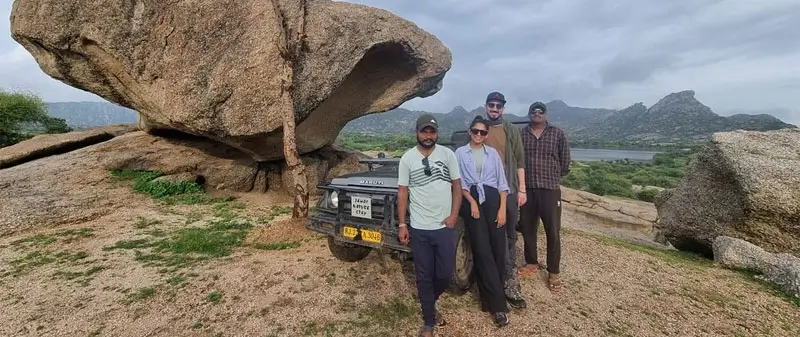
Jawai is not a dense tiger forest. Massive granite formations rise abruptly from scrubland, fields and villages. Leopards use caves and rocky shelters within these hills, creating one of Rajasthan's most unusual wildlife landscapes.
Arriving before late afternoon is ideal if an evening Jawai leopard safari has already been reserved.
At Jawai Nature Stay, current seasonal safari schedules list approximately 5:00 AM to 8:00 AM and 5:00 PM to 8:00 PM during summer, while winter drives are approximately 6:00 AM to 9:00 AM and 4:00 PM to 7:00 PM. Exact departure times can shift with daylight and local operating conditions, so guests should confirm the reporting time before the drive.
The property currently lists a private Jawai leopard safari price of approximately ₹4,500 per Gypsy per safari. Travellers should verify the latest rate and inclusions at the time of reservation.
Two nights are much better than one.
On the first evening, take a safari if arrival time permits. The following morning can be used for another leopard drive. After breakfast and rest, the afternoon can include Jawai Dam, birdwatching or simply time at the property before another sunset activity.
A private safari vehicle is particularly useful for photographers and families because the group has greater comfort and does not need to share its limited viewing space with unrelated travellers.
Leopard sightings cannot be guaranteed. The animals are wild and free-ranging. A responsible Jawai safari booking should therefore focus on the quality of the habitat and tracking experience rather than promises of a sighting.
Jawai deserves to be treated as a destination rather than a quick photo stop between Udaipur and Jodhpur.
A rushed itinerary often looks attractive on paper: arrive in the afternoon, take one safari, sleep, leave after breakfast. The problem is that wildlife does not follow hotel check-in schedules. If the single safari produces no leopard sighting, the traveller leaves without seeing much of the region.
Keeping two nights gives the trip breathing room.
A typical first evening can involve a private leopard safari in Jawai, followed by dinner and an early night. The next morning starts before sunrise or shortly afterward, depending on the season. Morning light across the granite hills is one of the strongest reasons to get out of bed early even when the temperature is cold.
Winter safari guests should carry a warm layer. Open Gypsy vehicles can feel considerably colder than hotel grounds before sunrise. In warmer months, light breathable clothing, sunglasses, sunscreen and drinking water are useful.
After the morning drive, return for breakfast rather than filling the middle of the day with another long road journey.
Jawai Dam can then be visited as a separate wildlife and landscape outing. The reservoir and surrounding wetland habitat are associated with birdlife and mugger crocodiles. Depending on season and water conditions, birdwatchers may see waterbirds and other species around the area.
Binoculars make a substantial difference.
Travellers should not approach crocodiles, walk too close to the water or attempt wildlife photographs from unsafe positions. Local guidance should take priority over the desire for a closer photograph.
The accommodation itself is also part of a Jawai wildlife stay. Travellers can select between tented accommodation and conventional rooms depending on comfort preferences. Families may prefer more spacious room arrangements, while couples and nature travellers often enjoy tented formats that better match the landscape.
When comparing package prices, ask for the complete amount rather than only the room tariff.
For example, a couple taking two private safaris at a listed rate of approximately ₹4,500 per vehicle would spend around ₹9,000 on the two safari drives alone, before accommodation, meals, taxes or additional activities. Four-person families occupying the same private Gypsy can calculate the effective safari cost differently because the vehicle charge is shared within their group.
A higher-side working budget for a comfortable two-night Jawai visit can therefore reasonably run from the mid-teens into ₹30,000 or more per couple, depending on room category, number of safaris, meals, private transfers and property standard. Premium luxury camps in the wider Jawai region can cost substantially more.
That is why package inclusions matter more than a headline rate.
Confirm whether breakfast and dinner are included, whether safari pickup is from the property, whether taxes are included, how many safari drives are provided and whether the quoted safari is private.
The strongest Rajasthan wildlife road trip is built around enough time to actually experience the landscape rather than collecting destination names.
After two nights in Jawai, the final major section runs towards Jodhpur.
The Jawai to Jodhpur distance is roughly 150 kilometres depending on the exact starting point and route, and travellers should generally keep approximately 3 to 4 hours for a comfortable road journey. Local traffic, stops and road conditions can alter the actual time.
There is no need to leave Jawai before dawn unless a flight or train schedule requires it. Guests who did not take a morning safari can have breakfast and depart at a relaxed hour.
Travellers interested in rural Rajasthan can add stops around smaller settlements along the broader route, but these should be selected carefully with the driver. Trying to insert too many detours can turn a pleasant three-hour transfer into an exhausting full-day drive.
Jodhpur provides a strong contrast to the previous few days.
After lakes, forested hills, temple valleys and leopard country, the Blue City brings the journey back into Rajasthan's monumental architecture. Mehrangarh Fort dominates the skyline and deserves several hours rather than a rushed visit before departure.
Nature-focused travellers can also pay attention to the rocky ecology around the fort. Rao Jodha Desert Rock Park was developed to restore the natural ecology of the rocky wasteland adjoining Mehrangarh. It is a particularly appropriate final stop for a trip built around Rajasthan's changing landscapes.
Walking here can be hot outside the cooler months. Morning or later-afternoon hours are generally more comfortable than the middle of the day. Visitors should check current opening hours and entry charges before arriving because seasonal schedules can vary.
One or two nights in Jodhpur are sufficient for most travellers completing this route.
A six-night structure can work as Udaipur – Kumbhalgarh – Jawai – Jodhpur, while travellers with eight nights can add more time in Udaipur, Kumbhalgarh or Ranakpur.
Driving distances remain manageable compared with itineraries that attempt to combine Udaipur, Jodhpur, Jaisalmer, Jaipur and Ranthambore within a single week.
This matters for families and senior travellers. Spending six or seven hours in a car every second day may allow more pins on a map, but it usually reduces the quality of the holiday.
The nature-focused route works because most driving sections are short enough to leave part of the day available for the destination itself.
After Udaipur, Kumbhalgarh and Ranakpur, arrive in a completely different landscape where granite hills meet open countryside and leopard habitat.
Costs vary enormously according to hotel category, car type and safari frequency, but a realistic budget framework helps prevent surprises.
For a private car with driver, keep roughly ₹3,500–₹6,500 per day as a broad working range for common sedan/SUV categories, while premium SUVs and luxury vehicles can cost more. Some operators quote per kilometre instead of per day and may apply minimum daily kilometre charges.
Always ask about driver allowance, tolls, parking, taxes and night charges.
Accommodation is the largest variable.
Comfortable mid-range accommodation across Udaipur, Kumbhalgarh and Jodhpur can often occupy a very different price band from premium heritage hotels. Wildlife camps around Jawai can also range from practical stays to high-end luxury camps costing several times more per night.
For travellers seeking comfort rather than ultra-luxury, a higher-side working accommodation budget of around ₹5,000–₹12,000 per room per night provides useful flexibility across much of the route. Premium heritage hotels and luxury safari camps can easily exceed this.
Food should also be budgeted separately when hotel packages do not include meals. Keeping roughly ₹1,500–₹3,000 per person per day provides comfortable room for meals at good hotels and restaurants, although local dining can cost significantly less.
Safari expenditure depends on the number of drives. Using Jawai Nature Stay's currently listed rate, two private leopard safaris would be around ₹9,000 per Gypsy.
Entry tickets, local guides, camera fees and optional activities add another layer.
For a comfortable private Rajasthan nature road trip of roughly seven nights, a couple can realistically keep a broad higher-side budget of around ₹90,000 to ₹1.6 lakh, excluding flights or long-distance rail tickets. Travellers selecting premium heritage hotels and top-tier safari camps can spend considerably more.
The useful point is not to chase the lowest possible number. It is to allocate money to the parts of the journey that matter: a reliable car, comfortable accommodation, enough time in each destination and multiple wildlife drives when sightings are a priority.
A strong route is Udaipur – Kumbhalgarh – Ranakpur – Jawai – Jodhpur. It combines lakes, Aravalli landscapes, forested areas, rural roads, granite leopard habitat and desert-rock ecology without requiring extremely long daily drives.
Around six to eight days works well. Travellers with more time can add additional nights in Udaipur, Kumbhalgarh or Jawai rather than adding distant cities.
Two nights are recommended for a comfortable Jawai safari stay. This provides enough time for more than one wildlife drive and additional activities such as Jawai Dam and birdwatching.
Jawai Nature Stay currently lists approximately ₹4,500 per Gypsy per safari for a private leopard safari. Current rates and inclusions should be reconfirmed when making the reservation.
Current approximate schedules are 5:00 AM–8:00 AM and 5:00 PM–8:00 PM in summer, and 6:00 AM–9:00 AM and 4:00 PM–7:00 PM in winter. Exact reporting times may change.
Yes. Ranakpur to Jawai is a convenient road connection, and Ranakpur's Jain temple complex and valley landscape make it a worthwhile stop rather than merely a fuel break.
Yes, provided the schedule is not rushed. Private road transport, two-night stays and avoiding repeated six-hour driving days make the route considerably more comfortable for senior travellers.
For roughly seven nights with private transport, comfortable accommodation, meals, sightseeing and Jawai safaris, a broad higher-side working budget of ₹90,000–₹1.6 lakh per couple is reasonable. Premium accommodation can push the total considerably higher.
Families commonly take Jawai wildlife safaris, but parents should consider the early starts, open-jeep conditions, weather and ability of younger children to remain comfortable during a multi-hour drive.
No. Leopards in Jawai are free-ranging wild animals, and sightings cannot responsibly be guaranteed. Booking more than one safari gives travellers more time in the habitat, but every drive should be approached as a genuine wildlife experience rather than a guaranteed sighting.
Planning to visit Jawai? Need help with your stay or safari?
Get free, expert assistance from our team — no pressure, just honest guidance.
Any query? Write us mail.
info@jawainaturestay.com
Call to Inquire (08:00 - 20:00 hrs)
+91 9257995999
Talk to Experts
Whatsapp