
Ranakpur, Kumbhalgarh and Jawai sit close enough to form one of southern Rajasthan's most rewarding short road journeys. Within a relatively compact region, travellers can move from an intricately carved Jain temple to an enormous hill fort and finish among granite formations where leopards live in the wider Jawai landscape.
A Ranakpur Kumbhalgarh Jawai road trip is particularly useful for travellers arriving from Udaipur and continuing towards Jodhpur. Instead of returning to a major city after every sightseeing stop, the route keeps moving through the Aravalli region and finishes with a genuine wildlife stay.
Two days is the minimum practical duration.
It should not be interpreted as two days in which every available attraction is squeezed into the schedule. The route works only when departure times are sensible, private transport is arranged and the second day is organised around Jawai's safari hours.
Rajasthan Tourism's suggested itineraries use approximately 50 kilometres between Ranakpur and Kumbhalgarh, although exact road distance varies by starting point and route. A realistic driving allowance is around 1.5 to 2 hours.
The journey from the Kumbhalgarh area towards Jawai is longer. Depending on the property and road selected, travellers should keep roughly three to four hours available for the broader transfer.
A private sedan for a two day regional journey can reasonably require around ₹7,000–₹10,000, while an SUV may cost approximately ₹9,000–₹14,000 or more. These are working budgets rather than fixed tariffs. Tolls, parking, driver allowance and minimum kilometre rules should be confirmed before booking.
The most important decision is where to sleep.
For a wildlife focused trip, the night should be spent in Jawai. This allows an evening safari if arrival is early enough and, more importantly, an early Jawai leopard safari the following morning.
Ranakpur is best handled early enough that the rest of the day does not become a race.
The Ranakpur Jain Temple is the major attraction. Its marble architecture, carved pillars and detailed interiors deserve substantially more time than a quick stop between hotels.
Travellers should check current visitor access hours before arriving because temple access for tourists and worshippers may follow different schedules. Photography permissions, camera charges and restrictions concerning belongings can also change.
Respectful clothing is essential.
Visitors should follow current temple instructions concerning leather items, food, photography and permitted areas rather than relying on an old online article.
Keep approximately 1.5 to 2 hours for the temple complex.
Travellers staying overnight around Ranakpur can have breakfast, check out and keep luggage safely in the vehicle before sightseeing. This avoids returning to the hotel simply to collect bags.
A late morning departure towards Kumbhalgarh generally works well.
Rajasthan Tourism itineraries place the Ranakpur to Kumbhalgarh distance at around 50 kilometres. Mountain roads mean the drive should not be judged by distance alone, and approximately 1.5 to 2 hours is a more useful scheduling figure.
The drive itself is part of the trip.
The route crosses sections of the Aravalli landscape where winding roads, villages and changing elevations make the journey very different from Rajasthan's long straight highways.
Lunch can be taken either before departure from Ranakpur or closer to Kumbhalgarh.
Do not schedule a heavy lunch immediately before a long fort walk.
Comfortable shoes matter at Kumbhalgarh because the fort complex involves slopes and walking. Carry drinking water, particularly during warmer months.
Travellers using a private car should tell the driver the full day's schedule before leaving Ranakpur. If the objective is to reach Jawai the same evening, the driver needs to know that Kumbhalgarh cannot turn into an open ended stop.
The route works because the major attractions receive enough time, not unlimited time.
Kumbhalgarh is not a roadside viewpoint.
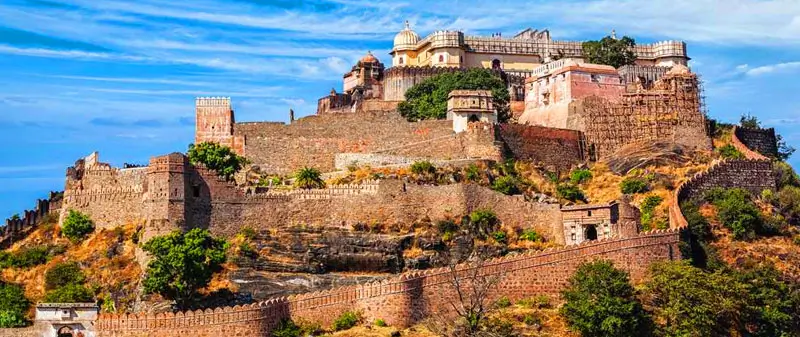
The fort was built during the reign of Rana Kumbha and occupies a commanding position above the Aravalli landscape. Its vast defensive wall is one of its most famous features, extending for approximately 36 kilometres according to Rajasthan Tourism.
The fort is also associated with Maharana Pratap, who was born at Kumbhalgarh.
For travellers on a Ranakpur to Kumbhalgarh road trip, keep at least three hours for a meaningful fort visit. Four hours are more comfortable for travellers interested in architecture and photography.
The terrain affects the visit.
Some sections involve uphill walking, and Rajasthan's afternoon heat can make the climb tiring. A hat, sunscreen, drinking water and comfortable footwear are basic requirements rather than optional extras.
Senior travellers should move at their own pace.
Trying to keep up with a fast group can make the visit unnecessarily exhausting. A private itinerary provides the advantage of setting your own walking speed.
Current entry charges and visitor timings should be verified before arrival because official fees can change.
Travellers should also check sunset related access conditions if visiting late in the day.
The surrounding hills are worth attention.
Kumbhalgarh Wildlife Sanctuary covers a broader forest landscape associated with animals such as leopards, wolves, hyenas, jackals and various herbivores. Travellers should not expect wildlife sightings during an ordinary fort transfer, but the sanctuary setting helps explain why this section of the Aravallis feels different from the city landscapes of Udaipur and Jodhpur.
For a strict two day itinerary finishing in Jawai, leaving Kumbhalgarh by mid afternoon is sensible.
Attempting to remain at the fort until late evening and then drive rural roads to Jawai after dark makes the day unnecessarily tiring.
If reaching Jawai in time for an evening safari is essential, departure needs to be even earlier.
During winter, Jawai Nature Stay currently lists an evening safari around 4:00 PM to 7:00 PM. Reaching Jawai after a full Ranakpur morning and a complete Kumbhalgarh visit before 4:00 PM can be unrealistic depending on the route.
Do not rush the driver.
The safer approach is to use the first day for Ranakpur, Kumbhalgarh and the road transfer, then reserve the principal leopard safari for the following morning.
The Kumbhalgarh to Jawai route is the longest road section of this short itinerary.
Exact distance depends heavily on the starting point around Kumbhalgarh and the location of the Jawai accommodation. The wider Jawai region contains multiple villages and properties rather than one central hotel district.
Keep approximately three to four hours as a sensible road allowance.
Leaving Kumbhalgarh during the afternoon allows arrival in Jawai around early evening, depending on traffic and road conditions.
A daylight arrival is preferable.
Rural property entrances can be less obvious than city hotels, and the granite landscape becomes much easier to appreciate when there is still some light.
Share the exact hotel location with the driver in advance.
Travellers should not simply tell a driver "Jawai" and assume every accommodation lies in the same place.
If the evening safari has already been missed, do not treat the day as unsuccessful.
Check in, have tea, walk around the property where permitted and prepare for the following morning.
A quiet evening is particularly valuable after several hours of temple sightseeing, fort walking and driving.
Accommodation in Jawai varies from straightforward nature stays to expensive luxury safari camps.
A comfortable room or tent can often be budgeted around ₹5,000–₹12,000 per night, depending on season, room category and inclusions. Premium camps can cost ₹20,000–₹50,000 or more, while the highest luxury categories in the region can rise far beyond this.
Ask whether dinner and breakfast are included.
Remote wildlife properties are not always surrounded by independent restaurants, so a slightly higher room tariff including meals can offer better value than a cheaper room only price.
A comfortable dinner and early bedtime are useful because the next morning starts early.
During summer, the currently listed morning safari at Jawai Nature Stay begins at approximately 5:00 AM.
During winter, it begins around 6:00 AM.
Exact reporting times should be confirmed the previous evening.
The second day is where the journey changes from heritage to wildlife.
A Jawai leopard safari typically takes place in an open Gypsy across the wider granite landscape. Drivers and local trackers watch rocky ridges, caves and movement areas where leopards may be observed.
Jawai Nature Stay currently lists the private safari at approximately ₹4,500 per Gypsy per safari.
The current seasonal morning schedule is approximately 5:00 AM–8:00 AM in summer and 6:00 AM–9:00 AM in winter.
These schedules can shift according to daylight and operating conditions. Confirm the current departure when making the reservation.
Winter guests should carry warm clothing.
An open safari vehicle moving before sunrise can feel considerably colder than the hotel courtyard. A jacket, scarf or warm layer makes the first hour much more comfortable.
During warmer periods, use light clothing, sunscreen and sunglasses.
Closed shoes are preferable in a wildlife environment.
Photographers should prepare equipment the previous evening rather than searching for batteries at 5:00 AM.
A telephoto lens in the 300mm–500mm range is particularly useful because leopards may appear high on distant granite formations. A wider lens can capture the extraordinary scale of the landscape.
Binoculars are highly recommended for non-photographers.
Most importantly, a leopard sighting cannot be guaranteed.
The animals are wild and free ranging. A responsible Jawai safari booking should never be sold as a guaranteed leopard encounter.
The landscape remains interesting even when a leopard does not appear immediately.
Guests may see birds, antelope, smaller mammals and rural activity, while the granite formations themselves create some of Rajasthan's most distinctive safari scenery.
After the morning drive, return to the accommodation for breakfast.
This is a good point to decide whether the journey should continue immediately or whether another night in Jawai would improve the trip.
Although the title of the route is a two day road trip, travellers with enough time should strongly consider two nights in Jawai.
One additional night makes another evening and morning safari possible and removes the pressure to leave immediately after breakfast.
Travellers who do not need to depart Jawai immediately can use the later morning or afternoon for Jawai Dam.
The reservoir gives the region a second wildlife identity beyond leopards.
Birdlife around the wider wetland can be rewarding, particularly for guests carrying binoculars or telephoto lenses. Mugger crocodiles are also associated with the reservoir environment.
Wildlife safety is important.
Do not approach crocodiles, move too close to the water or stand in unsafe locations simply for photographs. Follow the advice of local guides.
The middle of the day can also be used for rest.
This is particularly useful for families and senior travellers who have already completed an early safari.
A property with a swimming pool or outdoor seating can turn the afternoon into part of the holiday rather than dead time between activities.
If taking another evening leopard drive, the current approximate safari schedules are 5:00 PM–8:00 PM in summer and 4:00 PM–7:00 PM in winter.
A second safari costs another approximately ₹4,500 per Gypsy at the currently listed Jawai Nature Stay rate.
For wildlife enthusiasts, the extra drive is usually more valuable than trying to fit another distant attraction into the day.
Different safari times provide different light and animal movement conditions.
Two drives would bring the current private safari total to approximately ₹9,000 per Gypsy.
Travellers continuing towards Jodhpur after the morning safari should keep roughly three to four hours for the wider Jawai to Jodhpur road journey, depending on the accommodation location and selected route.
Leaving immediately after breakfast can make arrival in Jodhpur possible during the afternoon.
Travellers returning to Udaipur should expect more backtracking. This is why Jawai fits particularly well when the broader Rajasthan journey is already moving towards Jodhpur.
The cost should be calculated across transport, accommodation, entry tickets, meals and safari activity.
Private transport is likely to cost approximately ₹7,000–₹10,000 for a sedan across a two day regional arrangement, depending on total distance and operator.
An SUV can reasonably cost around ₹9,000–₹14,000 or more.
Ask whether the quote includes driver allowance, tolls, parking and overnight charges.
Some operators calculate the trip on a per-kilometre basis and apply a minimum daily distance.
Accommodation in Jawai can be budgeted broadly from around ₹5,000–₹12,000 per room per night for comfortable categories, although rates vary significantly.
Premium wildlife camps can cost much more.
A private leopard safari currently adds approximately ₹4,500 per Gypsy.
Two safaris add approximately ₹9,000.
Meals can add around ₹2,000–₹5,000 per couple per day at comfortable properties if not included in the room package.
Temple and fort entry charges should be kept separately because applicable visitor fees and photography charges can change.
For a couple taking a private car, one comfortable Jawai night and one leopard safari, a realistic working total can fall around ₹20,000–₹30,000, excluding accommodation already paid in Ranakpur.
With a better room, SUV and two safaris, the total can move towards ₹30,000–₹45,000 or more.
A second night in Jawai naturally increases accommodation and meal costs but substantially improves the wildlife portion of the journey.
The important point is to spend where it changes the experience.
A reliable car matters. Enough time at Kumbhalgarh matters. A private safari matters for travellers who value comfort and photography.
Trying to reduce the journey to the cheapest possible figure often results in long driving hours and rushed sightseeing.
The route works because the destinations are different.
Ranakpur is about architecture and detail.
Kumbhalgarh is about scale, history and the Aravalli landscape.
Jawai is about wildlife, granite formations and the uncertainty of tracking free ranging leopards.
Do not make all three compete for the same afternoon.
If the first day begins late, remove something rather than asking the driver to make up time on rural roads.
If Ranakpur is particularly important, stay longer at the temple and accept that the first Jawai safari will be the next morning.
If Kumbhalgarh is the priority, keep several hours for the fort and arrive at Jawai after sunset only if the driver is comfortable with the road.
If wildlife is the main purpose, consider visiting Kumbhalgarh on another day and reaching Jawai early enough for the evening drive.
For most travellers, the balanced schedule is straightforward:
Ranakpur morning → Kumbhalgarh afternoon → Jawai overnight → Jawai morning safari → breakfast → Jawai Dam or onward journey.
Those who can add another night should do so.
The extra time changes Jawai from a single safari into a genuine wildlife stay.
Yes. Jawai fits naturally into a broader Udaipur–Ranakpur–Kumbhalgarh–Jawai–Jodhpur route. The Jawai to Jodhpur drive generally requires around three to four hours depending on the exact property and road.
Carry closed shoes, water, binoculars, sunglasses and sun protection. Winter mornings require warm clothing. Wildlife photographers should consider a 300mm or longer telephoto lens.
No. Leopards are free-ranging wild animals. No responsible safari operator can guarantee a sighting.
One night works for a tight itinerary and one morning safari. Two nights in Jawai are considerably better for travellers who want multiple wildlife drives and a less rushed stay.
Keep roughly ₹7,000–₹10,000 for a sedan and approximately ₹9,000–₹14,000 or more for an SUV, depending on distance, vehicle and operator conditions.
Current approximate timings are 5:00 AM–8:00 AM and 5:00 PM–8:00 PM in summer, and 6:00 AM–9:00 AM and 4:00 PM–7:00 PM in winter.
Jawai Nature Stay currently lists approximately ₹4,500 per Gypsy per safari. Current pricing and inclusions should be confirmed at booking.
It may be possible with a very early schedule, but it should not be assumed. Winter evening safaris can begin around 4:00 PM, making a same-day Ranakpur and full Kumbhalgarh visit difficult before safari departure.
Yes, but the schedule must be disciplined. A practical route is Ranakpur → Kumbhalgarh → Jawai overnight, followed by a Jawai leopard safari the next morning.
Rajasthan Tourism itineraries use approximately 50 kilometres between Ranakpur and Kumbhalgarh. Keep around 1.5 to 2 hours for the road journey because mountain roads can slow travel.
Planning to visit Jawai? Need help with your stay or safari?
Get free, expert assistance from our team — no pressure, just honest guidance.
Any query? Write us mail.
info@jawainaturestay.com
Call to Inquire (08:00 - 20:00 hrs)
+91 9257995999
Talk to Experts
Whatsapp