India's luxury wildlife circuit is often associated with famous national parks such as Ranthambore, Bandhavgarh, Kanha and Pench. These destinations are excellent for travellers who want traditional forest safaris, but they represent only one side of wildlife travel in India.
Some remarkable stays are located beyond the conventional national park experience. Leopards move across granite hills in Rajasthan. Crocodiles and gharials inhabit river ecosystems. Elephants cross forest corridors outside tightly defined tourism zones. Wetlands support thousands of birds, while private conservation landscapes allow guests to spend time in nature without structuring the entire holiday around a national park gate.
For travellers searching for luxury safari lodges in India outside national parks, the appeal is often as much about location as accommodation.
A high-quality wildlife stay should provide comfortable rooms or tents, knowledgeable local guides, responsible wildlife practices, good food and enough time outdoors. Luxury should not mean vehicles crowding an animal for photographs or making unrealistic promises about sightings.
Prices vary enormously. A comfortable wildlife property outside a national park may begin around ₹8,000–₹15,000 per room per night, while premium camps and internationally recognised conservation lodges can run from ₹30,000 to ₹1 lakh or more per night, particularly when meals and private activities are included.
Travellers should therefore compare the complete package rather than room rates alone.
Jawai, Kabini, Chambal, Satpura's wider conservation landscape and several lesser-known wilderness regions demonstrate that an Indian safari holiday does not have to begin and end at a national park gate.
Jawai is one of the clearest examples of an Indian wildlife destination whose identity differs from a conventional national park safari.
The landscape is defined by enormous granite formations, scrub, agricultural fields, villages and the Jawai reservoir. Leopards use caves and rocky outcrops across this terrain, while local communities live and work in the surrounding countryside.
That relationship gives a Jawai leopard safari a completely different visual character from a tiger safari through a protected forest.
Safari vehicles generally travel through rocky tracks and open terrain while drivers and trackers scan ridges, caves and known movement areas. A leopard may appear high on a granite formation rather than walking beside the vehicle, which makes binoculars and telephoto lenses particularly useful.
Jawai's accommodation market ranges from practical nature stays to some of India's most expensive luxury camps.
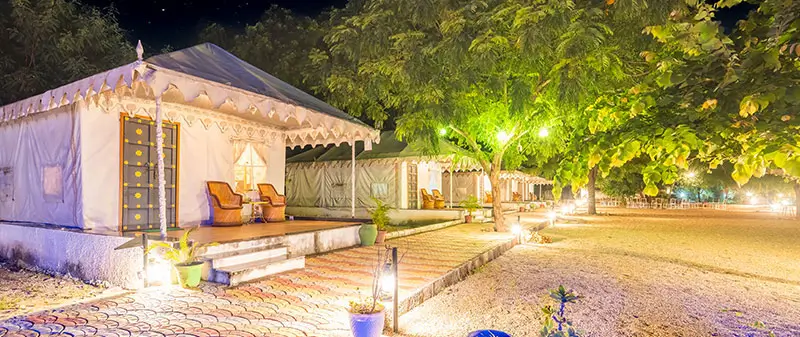
At the accessible end of the market, properties such as Jawai Nature Stay allow travellers to combine tented or room accommodation with private leopard drives. The property currently lists a private leopard safari in Jawai at approximately ₹4,500 per Gypsy per safari.
Its seasonal schedules currently show summer drives at approximately 5:00 AM–8:00 AM and 5:00 PM–8:00 PM, with winter drives around 6:00 AM–9:00 AM and 4:00 PM–7:00 PM. Guests should reconfirm current times and safari prices because operating conditions can change.
At the premium end, Jawai has become known for highly designed tented camps and private wilderness-style accommodation. Prices at the top properties can move into ₹50,000–₹1 lakh-plus per night, depending on season, tent category, meals, taxes and activities.
That enormous price difference is important.
A traveller does not need to spend ₹1 lakh per night simply to take a leopard safari. The same wider landscape contains accommodation at very different price points.
For most visitors, two nights in Jawai are the practical minimum. Three nights suit photographers and travellers who want multiple drives without rushing.
Leopard sightings should never be guaranteed. Wild animals move freely, and a responsible lodge should set realistic expectations.
Jawai Dam adds birdwatching and crocodile habitat to the stay. The combination of granite hills, leopard tracking, rural landscapes and water makes Jawai one of the strongest alternatives for travellers who want a luxury wildlife stay in Rajasthan without repeating the conventional tiger-reserve format.
Experience Rajasthan’s wild side in a more intimate way. Stay close to Jawai’s dramatic granite landscape, discover its free-ranging leopards and enjoy a personalised safari experience designed around comfort, nature and unforgettable moments.
Kabini is different from Jawai because the wider wildlife experience is closely associated with the forests around Nagarhole rather than being entirely outside a protected-area system. However, the accommodation experience along the Kabini River has become a destination in its own right.
For travellers comparing luxury wildlife resorts in India, Kabini deserves attention because the landscape combines forest, river, grassland edges and a strong wildlife reputation.
Elephants are one of the major attractions of the wider region. The forests are also associated with tigers, leopards, gaur, deer, wild dogs and extensive birdlife.
Kabini's premium lodges generally place greater emphasis on the complete stay than a simple hotel beside a safari gate. River views, nature walks where permitted, boat-based experiences, birdwatching and carefully designed accommodation can fill the hours between wildlife activities.
Luxury pricing can be substantial.
Depending on property and season, comfortable upscale accommodation may fall roughly around ₹15,000–₹30,000 per night, while top-tier lodges and villas can rise considerably higher. Some packages include meals and selected activities, while safari costs or premium experiences may be charged separately.
Travellers should ask one particularly important question before paying: Does the room tariff include the wildlife activity you actually want?
A beautiful room beside a river is not automatically a safari package.
Government-regulated forest safaris may have limited seats and specific booking systems. A lodge cannot simply create additional official safari capacity because a guest has paid for an expensive suite.
This makes advance arrangements important.
Kabini also suits travellers who value downtime. Instead of scheduling every morning and afternoon around a jeep, guests can spend part of the trip watching the river, photographing birds or enjoying the property.
Three nights are particularly comfortable. Two nights work for a shorter holiday but provide less flexibility.
Kabini and Jawai therefore attract some of the same travellers for different reasons. Jawai offers granite hill leopard safari and rural Rajasthan. Kabini provides a greener southern Indian landscape with river and forest ecology.
Both demonstrate that the accommodation can become an important part of the wildlife journey rather than merely somewhere to sleep between drives.
Travellers who associate Indian safari holidays exclusively with tigers often overlook the National Chambal Sanctuary landscape.
The Chambal River ecosystem supports one of India's most distinctive wildlife experiences. Instead of spending the morning driving forest tracks in search of a big cat, visitors can take boat-based wildlife excursions looking for gharials, mugger crocodiles, river birds and, with luck, Gangetic river dolphins.
This is a completely different form of safari.
The river's open views are particularly good for birdwatchers and photographers. Depending on season and location, travellers may encounter skimmers, terns, lapwings, raptors, waterbirds and other species associated with the river and its banks.
For serious wildlife travellers, Chambal works particularly well as a contrast to nearby heritage destinations.
It can be incorporated into a north Indian journey involving Agra rather than requiring a dedicated expedition across the country. This makes it valuable for international visitors who want wildlife but do not have enough days to add a distant tiger reserve.
Accommodation around the Chambal region is smaller in scale than India's most famous luxury tiger lodges. That can be an advantage.
A good nature lodge here should focus on knowledgeable naturalists, comfortable rooms, quality meals and access to river activities rather than excessive resort infrastructure.
Working room budgets may sit around ₹10,000–₹25,000 per night for good wildlife-oriented accommodation, while premium packages and specialised excursions can increase the total. Rates vary according to season and inclusions.
Boat safari charges should be checked separately.
Travellers need to ask whether the quoted amount covers a private or shared boat, guide or naturalist fees, transport to the boarding point and any sanctuary-related charges.
Timing matters as well.
Early mornings and late afternoons are generally more comfortable for wildlife observation and photography. Winter can be particularly attractive for birding, but mornings on the river may be cold. Warm layers are useful even when daytime temperatures become pleasant.
Chambal is ideal for travellers who have already taken several tiger safaris and want a different wildlife safari in India.
It is also an excellent reminder that luxury wildlife travel does not need to depend on a dramatic predator sighting. Watching a gharial resting on a sandbank or photographing river birds in soft morning light can be every bit as memorable as waiting for a tiger beside a forest road.
The names Jawai and Bera are frequently used in discussions about Rajasthan's leopard country, and travellers should understand that accommodation and safari operators may describe locations across the wider region differently.
The important feature is the granite landscape.
This part of Rajasthan contains rocky hills, caves, fields, small settlements and water bodies rather than a single enclosed national park environment. Leopards have adapted to this terrain, and safari activity is built around reading the landscape and searching likely rocky shelters.
For someone searching for leopard safari outside national parks in India, the wider Jawai-Bera region is therefore particularly significant.
Accommodation varies dramatically.
There are simple local stays, comfortable camps, boutique properties and ultra-luxury safari lodges. A couple can build a reasonably comfortable two-night wildlife break without entering India's highest luxury price category, while travellers seeking private pools, designer tents, dedicated vehicles and highly personalised dining can spend several times more.
The biggest mistake is comparing properties purely by room photographs.
Before reserving any Jawai luxury safari lodge, ask how the safari operates. Find out whether the vehicle is private, how long a drive usually lasts, whether safari pickup begins directly from the accommodation, how many guests sit in a vehicle and whether the naturalist or driver has extensive local experience.
Also ask how many drives are sensible for your stay.
A single safari keeps costs lower but leaves the entire wildlife component dependent on a few hours. Two or three drives give travellers a much better feel for the terrain.
At the current approximate private safari rate published by Jawai Nature Stay, two Gypsy drives would total around ₹9,000 per vehicle before accommodation and other activities.
For photographers, three or four drives may be worthwhile.
Morning and evening also produce very different light on the granite. Leopards resting high on the rocks can require long focal lengths, while wider lenses are valuable for landscape photographs.
The destination is not only about leopards. Birdlife, crocodiles around Jawai Dam, village landscapes and the Aravalli foothills broaden the trip.
This is particularly useful for couples where only one traveller is a serious wildlife photographer. The stay can still offer scenery, comfortable accommodation and quiet time rather than forcing both guests into repeated forest drives.
Step beyond the traditional safari and discover the rare beauty of Jawai. From elegant stays to private leopard drives, experience a wilderness journey where refined comfort meets authentic Rajasthan.
The word "luxury" has become so common in Indian travel marketing that it can mean almost anything from an air-conditioned tent to a private villa costing more than an international flight.
For a luxury safari lodge in India, price alone is a poor measure.
Location comes first.
A beautiful resort that requires a long daily transfer to wildlife activity may be less useful than a simpler property positioned close to the landscape the guest actually came to see.
Naturalist quality matters just as much.
A knowledgeable guide can explain tracks, calls, bird behaviour, geology and local ecology during the long periods when a big cat is not visible. That turns a safari from a search for one photograph into an actual wildlife experience.
Vehicle quality matters, particularly on rocky routes. Guests should know whether a safari is private or shared and how many people will occupy each row.
Food is another practical consideration.
Many remote wildlife lodges operate on full-board packages because there may be few independent restaurants nearby. Ask whether breakfast, lunch, dinner, tea and drinking water are included. Guests with dietary requirements should communicate them before arrival rather than assuming a remote kitchen can immediately provide every request.
Room design should fit the climate.
Heating or adequate winter bedding can matter during cold mornings in Rajasthan. Air-conditioning becomes important during hotter periods. Reliable hot water, clean bathrooms, charging points and good mattresses may contribute more to actual comfort than decorative furniture.
Sustainability claims also deserve scrutiny.
A genuinely responsible property should manage waste carefully, limit disturbance around wildlife, respect local communities and avoid pressuring drivers to approach animals too closely.
Luxury should buy better time in nature, not greater entitlement over wildlife.
Travellers should also check cancellation policies. Wildlife trips frequently involve multiple connected bookings—hotel, safari, car and flight. A cheap non-refundable package can become expensive if travel dates change.
A useful wildlife budget should be divided into accommodation, activities, transport and meals.
At the comfortable end, keep roughly ₹8,000–₹15,000 per room per night for selected nature properties outside the most expensive luxury tier. Depending on location, meals may or may not be included.
Around ₹15,000–₹35,000 per night opens a broader range of boutique wildlife lodges and premium camps.
Beyond ₹35,000 per night, travellers enter a segment where private villas, highly designed tented camps, full-board dining and personalised activities become more common.
India's most exclusive safari lodges can exceed ₹1 lakh per night during high-demand periods.
Transport is separate unless a package says otherwise.
A private road transfer may cost roughly ₹3,500–₹7,000 or more per day depending on distance and vehicle type. Airport transfers to remote wilderness areas can be significantly higher.
Activities also matter.
In Jawai, using the currently published approximate rate of ₹4,500 per private Gypsy safari, two drives add about ₹9,000 per vehicle.
At river or forest destinations, boat safaris, official park drives and naturalist services have their own fee structures.
For a comfortable two-night wildlife break, a couple can therefore easily spend ₹30,000–₹60,000, including accommodation, meals, private road transport and activities. A high-end two-night stay can exceed ₹1 lakh, while ultra-luxury camps can cost considerably more.
Paying more makes sense when the additional cost delivers something tangible: exceptional location, outstanding guiding, a private vehicle, better accommodation, excellent food or meaningful conservation work.
The best luxury wildlife stays in India are not necessarily those with the largest rooms. They are the properties that make it easier to spend meaningful time in the landscape without sacrificing comfort.
For travellers following a Rajasthan itinerary, Jawai is particularly convenient because wildlife can be inserted between Udaipur and Jodhpur rather than requiring a flight to a distant tiger reserve.
That geographic convenience, combined with private leopard drives and a broad accommodation range, makes it one of India's most practical alternatives to a conventional national park safari holiday.
There is no single answer for every traveller. Jawai is particularly strong for leopard safaris and granite landscapes, while Chambal is excellent for river wildlife and birding. Kabini offers a premium river-and-forest setting connected to the wider Nagarhole landscape.
No. Jawai's leopard safari landscape is different from a conventional national park tourism system. Leopards use granite hills and caves across a landscape that also contains villages, fields and water bodies.
Comfortable properties may cost around ₹8,000–₹15,000 per room per night, while premium lodges commonly move beyond ₹20,000–₹35,000. India's most exclusive safari camps can exceed ₹1 lakh per night.
Jawai Nature Stay currently lists a private Jawai leopard safari at approximately ₹4,500 per Gypsy per safari. Guests should reconfirm current pricing and inclusions when reserving.
Two nights are a practical minimum. Three nights are better for photographers or travellers wanting multiple Jawai wildlife safari drives without a rushed schedule.
No. Leopards are wild and free-ranging animals. No responsible safari lodge or operator should guarantee a sighting.
Yes. Couples can combine private leopard safaris with tented accommodation, Jawai Dam, birdwatching and relaxed time at the property. Accommodation ranges from comfortable nature stays to ultra-luxury camps.
Check room inclusions, meal arrangements, safari charges, private versus shared vehicles, taxes, transfers, cancellation terms and activity availability. Do not assume an expensive room automatically includes wildlife drives.
The Chambal River landscape is a strong option for travellers interested in gharials, crocodiles, river dolphins and birdlife. It provides a completely different wildlife experience from a tiger safari.
Yes. Jawai fits particularly well into an Udaipur–Ranakpur–Jawai–Jodhpur road journey. This allows travellers to add a dedicated wildlife stay without making a major diversion from a western Rajasthan itinerary.
Planning to visit Jawai? Need help with your stay or safari?
Get free, expert assistance from our team — no pressure, just honest guidance.
Any query? Write us mail.
info@jawainaturestay.com
Call to Inquire (08:00 - 20:00 hrs)
+91 9257995999
Talk to Experts
Whatsapp